KLOW Dosage per Day and per Week
The main schedules documented here use 3.2 mg or 4 mg of total KLOW per dosing day. The weekly amount depends on whether the schedule runs every day or five days per week. At 4 mg, that difference is 28 mg versus 20 mg per week.1237
| Total blend per dosing day | Frequency | Total per week | Duration described |
|---|---|---|---|
| 3.2 mg | Every day | 22.4 mg | About six weeks2 |
| About 4 mg | Every day; split AM / PM | About 28 mg | Six weeks1 |
| 4 mg | Five days per week | 20 mg | Two months completed3 |
| 3.2 mg | Monday–Friday | 16 mg | Twelve-week plan7 |
Daily dosing versus five days on, two days off
A daily schedule uses the same amount on all seven days. A five-day schedule leaves two days without KLOW and uses less product over the same calendar period. With a 4 mg dosing-day amount, an 80 mg vial contains twenty portions: 20 days of daily use or four weeks at five portions per week, before losses. The available reports do not establish that one schedule works better.
Does the amount mean the whole blend or each ingredient?
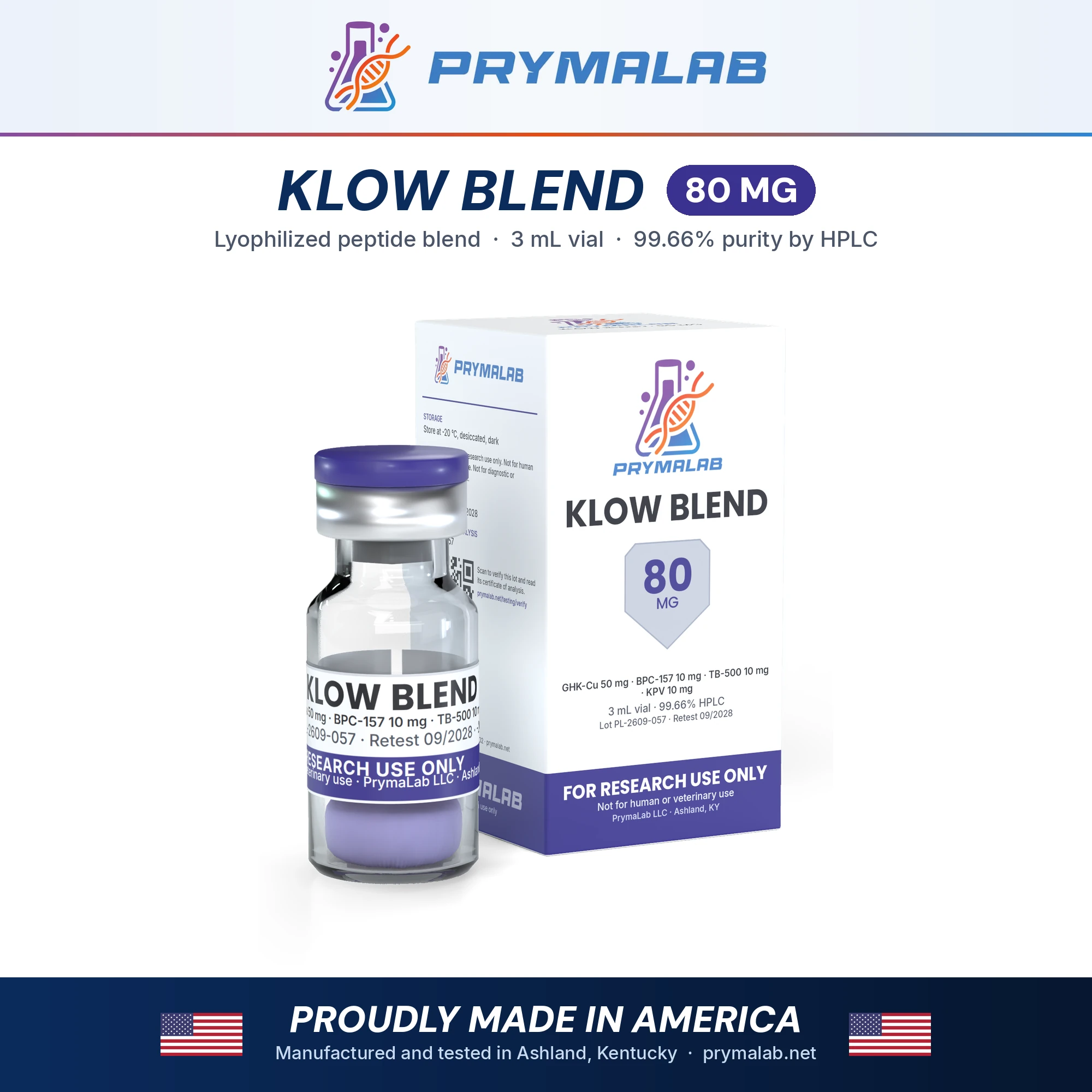
All amounts on this page mean the whole blend. For the 50/10/10/10 mg formula, 4 mg KLOW contains 2.5 mg GHK-Cu plus 0.5 mg each of BPC-157, TB-500 and KPV. A 3.2 mg total contains 2 mg GHK-Cu plus 0.4 mg of each other component. This distinction prevents a four-ingredient amount being mistaken for four separate doses.12
How Community KLOW Protocols Are Structured
Fixed daily amounts
Fixed schedules keep the total unchanged across the course: for example, about 4 mg daily over six weeks, or 4 mg on five days each week over two months. This makes weekly use straightforward to calculate and avoids changing both the amount and frequency at once.13
Dividing the daily total
Some routines divide the day’s amount between morning and evening. A 4 mg total split into 2 mg AM plus 2 mg PM still adds up to 4 mg for that day. It is not 4 mg twice daily. No comparison in these sources establishes that splitting the amount gives stronger or faster results.15
Lower-start progression
A lower-start pattern begins at 2 mg on dosing days, increases to 3 mg, then holds at 4 mg. The documented eight-week plan used five days on and two off. Its progression is shown as a community example, not a standard beginner prescription.45
| Stage | Amount per dosing day | Schedule | Calculated weekly total |
|---|---|---|---|
| Weeks 1–2 | 2 mg | Five days on / two off | 10 mg |
| Week 3 | 3 mg | Five days on / two off | 15 mg |
| Weeks 4–8 | 4 mg | Five days on / two off | 20 mg |
The full eight weeks were a plan at the time of posting. The same source reported weakness during an earlier 5 mg cycle and later clarified staying at 4 mg. Increasing the amount is therefore not an evidence-based shortcut to better results; new symptoms warrant stopping and seeking clinical advice.45
How Long Is a KLOW Cycle?
Six weeks, two months and ten-week courses appear in completed or ongoing community use. Twelve weeks also appears as a plan. Shorter and longer courses differ in total exposure, cost and time available to observe a change; these accounts do not establish an ideal cycle.1367
| Duration | Where it fits | Practical advantage | Trade-off |
|---|---|---|---|
| 4 weeks | A short comparison period; one 80 mg vial at 4 mg, five days weekly. | Less product and fewer dosing days. | Ends before some six-to-eight-week improvement reports; not an established effective course. |
| 6 weeks | A reported course with comfort and cosmetic follow-ups.18 | Enough time to overlap with several positive six-week updates. | Some people report no visible cosmetic change over a similar period.2 |
| About 8–9 weeks | Two months of completed weekday-style use.3 | More observation time than a four-to-six-week course. | More exposure and cost; this schedule report did not supply a benefit outcome. |
| 10 weeks | A reported repeating cycle with four weeks off.6 | Extends beyond the six-to-eight-week onset described in that account. | Longer use has not been shown to outperform a shorter course. |
| 12 weeks | An extended community plan, followed by four weeks off.7 | The longest observation window in these cycle examples. | The full course was not confirmed completed; extra benefit and long-term safety remain unestablished. |
Breaks between cycles
Four weeks off appears after ten-week courses and in a twelve-week plan. A break reduces exposure during that interval. There is no evidence here that four weeks is an optimal interval, clears excess copper, resets receptors or makes repeated use safe.6711
How many 80 mg vials does a cycle use?
| Duration | Five days per week | Every day |
|---|---|---|
| 4 weeks | 80 mg · 1 vial | 112 mg · 2 vials |
| 6 weeks | 120 mg · 2 vials | 168 mg · 3 vials |
| 8 weeks | 160 mg · 2 vials | 224 mg · 3 vials |
| 10 weeks | 200 mg · 3 vials | 280 mg · 4 vials |
| 12 weeks | 240 mg · 3 vials | 336 mg · 5 vials |
Quantities are calculated from total mass and rounded up, without waste. They do not establish how long a mixed vial stays usable. See cycle cost examples for current sampled market prices.
How to Reconstitute KLOW: Step by Step
The worked example uses an 80 mg powder vial and 3 mL of diluent, a volume described in community use. Assuming a final solution volume of 3 mL, the result is approximately 26.67 mg of total blend per mL. The prefilled pen already contains liquid and does not need reconstitution.3
This is a laboratory preparation example. Use it only where the product’s instructions confirm that the diluent, volume and vial capacity are suitable. Bacteriostatic water is not compatible with every preparation and does not make research powder suitable for human injection.10
Supplies
An 80 mg vial, the specified sterile diluent, a new sterile transfer syringe able to measure 3 mL, a compatible needle, alcohol swabs, a clean work surface, a label and a sharps container.
- Prepare the area and vials.Wash and dry your hands and clean the work surface. Check labels, expiry dates and intact seals. Let a cold, sealed powder vial reach room temperature before opening or puncturing the sealed vial to limit moisture condensation.917
- Disinfect the rubber stoppers.Wipe both the powder-vial and diluent-vial stoppers with 70% alcohol and let them air-dry. Keep fingers away from the cleaned surfaces.18
- Measure the diluent.For this worked example, draw 3.0 mL of the compatible diluent into a new sterile transfer syringe. Read the volume at the appropriate plunger edge; keep the needle and connection untouched.
- Transfer and mix.Add the liquid slowly down the inside wall of the powder vial. Gently rotate or swirl until dissolved; do not shake vigorously. If the powder does not dissolve as expected, stop and obtain product-specific instructions rather than adding other solvents.
- Inspect and label.Check for unexpected particles or a change from the product’s specified appearance. Label the vial with its name, total mass, final volume, concentration and preparation date. A clear solution alone does not prove sterility.10
- Store and discard correctly.Follow the prepared product’s temperature, light-protection and in-use expiry instructions. Dispose of the transfer needle and syringe immediately. Discard material if sterility is in doubt.915
80 mg ÷ 3 mL = 26.67 mg/mL of total KLOW blend.
Mixed-vial storage: the supplied powder documentation does not establish a post-mixing expiry. A generic 28-day rule for a multidose vial is not a demonstrated KLOW shelf life. Obtain formulation-specific storage and discard instructions; do not assume refrigeration supplies a missing expiry.910
KLOW Reconstitution and Measurement Chart
More water makes a more dilute solution; it does not change the 80 mg of blend in the vial. On a U-100 syringe scale, 100 units equal 1 mL. These are volume markings, not KLOW potency units. Count the scale value, not the number of printed tick marks.
| Final solution volume | Blend concentration | Blend in 0.10 mL | Volume containing 4 mg |
|---|---|---|---|
| 2 mL | 40 mg/mL | 4 mg | 0.10 mL · 10 U-100 units |
| 2.5 mL | 32 mg/mL | 3.2 mg | 0.125 mL · 12.5 U-100 units |
| 3 mL | 26.67 mg/mL | 2.67 mg | 0.15 mL · 15 U-100 units |
80 mg in a final 3 mL: worked measurements
| Total blend amount | Solution volume | U-100 scale value | Ingredients within that total |
|---|---|---|---|
| 2 mg | 0.075 mL | 7.5 units | 1.25 mg GHK-Cu + 0.25 mg each of the other three |
| 3.2 mg | 0.12 mL | 12 units | 2 mg GHK-Cu + 0.4 mg each of the other three |
| 4 mg | 0.15 mL | 15 units | 2.5 mg GHK-Cu + 0.5 mg each of the other three |
Calculations use the labeled 50/10/10/10 mg formula and the stated final volume. Fractional scale values require equipment with adequate precision. These calculations do not validate the mixture for injection or determine a pen’s click setting.12
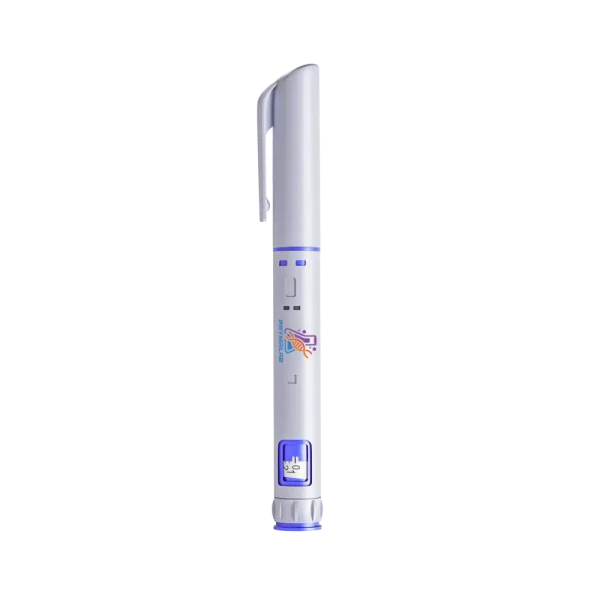
Powder vial and pen are different concentrations. The featured pen contains 240 mg in 3 mL, or 80 mg/mL. It is three times as concentrated as the 80 mg-in-3 mL example. Follow that specific device’s instructions; never transfer the vial’s scale values to the pen.
General Subcutaneous Injection Guide
A subcutaneous injection delivers medicine into the fatty layer beneath the skin. The steps here explain standard care for a clinician-prescribed subcutaneous medicine. They do not establish a suitable route or safe self-injection protocol for research KLOW.1314
Where are subcutaneous injections given?
Common sites are the abdomen, outer upper thigh and side or back of the upper arm. On the abdomen, stay at least 2 inches / 5 cm from the navel. Choose healthy skin, avoid bruised, red, swollen or scarred areas, and rotate locations. MedlinePlus advises at least one inch between successive sites.13
- Check the medicine and equipment.Confirm the prescribed medicine, amount, route and expiry. Use the needle and syringe specified for it, with intact sterile packaging. Keep gauze and a sharps container within reach.13
- Clean your hands and the site.Wash your hands. Clean the selected skin with a fresh alcohol pad and let it dry. Avoid touching the cleaned area.14
- Use the technique demonstrated for your device.A clinician should show the correct skin fold, needle length and insertion angle. Standard syringe guides describe angles of 45–90°, depending on tissue depth and equipment; there is no single angle appropriate for every person and device.1314
- Deliver the prescribed amount.For a syringe, use the demonstrated technique and depress the plunger steadily. Remove the needle as instructed. A pen has its own preparation, priming and hold-time instructions; use that exact device guide.14
- Apply pressure and dispose.Use gentle gauze pressure for minor bleeding; do not rub. Put the used needle and syringe straight into a sharps container. Do not recap or reuse them, or re-enter a vial with used equipment.9141518
Aftercare: when to seek help
Contact a clinician for spreading redness, swelling, red streaks or fever. Sudden throat or tongue swelling, breathing difficulty, severe dizziness or collapse requires emergency help. Do not continue injecting through a suspected reaction or infection.1316
Dispose of the sharps container according to its fill limit and local requirements. Never place loose needles in household rubbish or recycling.15
When Do Reported KLOW Effects Appear?
Comfort and recovery changes are described over roughly four to eight weeks. Reports include gradually easier biceps movement around one month, fewer aches and shoulder discomfort at six weeks, and better knee or joint comfort beginning around weeks six to eight. Exercise changes and other compounds also occurred in these accounts.126
Skin, hair and nail changes appear in a completed six-week update: softer skin, lighter-looking scars, stronger nails and slightly thicker hair. That account also included topical skincare, diet changes and retatrutide. Other people report no cosmetic improvement over a similar period.28
These are reported observation windows, not a week-by-week promise. They do not show that increasing the dose or extending a cycle causes better results. The benefits timeline covers earlier digestive and hair-shedding observations, while the benefits guide explains the main effects and ingredient research.
KLOW Dosage, Preparation & Injection FAQ
What daily KLOW amount do people use?
How much is that per week?
At 4 mg, five dosing days equal 20 mg per week; daily use equals 28 mg. At 3.2 mg, the corresponding totals are 16 mg and 22.4 mg. A split AM/PM schedule uses the same daily total, not double.
How long does an 80 mg vial last?
It contains twenty 4 mg portions or twenty-five 3.2 mg portions, before losses. Twenty 4 mg portions cover 20 daily dosing days or four weeks at five portions per week. Product quantity and post-mixing expiry are separate limits.
How much water goes into an 80 mg KLOW vial?
The worked example is 3 mL of a product-compatible diluent, producing approximately 26.67 mg/mL if the final volume is 3 mL. Confirm capacity and compatibility first; follow the six preparation steps.310
Does 10 units mean 4 mg?
Only with 80 mg in a final 2 mL, using a U-100 scale. At a final 3 mL, 10 U-100 units contain about 2.67 mg; 15 contain 4 mg. The dilution chart shows all three concentrations.
Should KLOW be used in the morning or at night?
How long are cycles and breaks?
Should injections go near an injury?
The reviewed evidence does not establish a benefit from placing KLOW near an injured tendon or joint. The general guide concerns medication delivered into subcutaneous fat. It is not a guide to injecting joints, tendons or muscle.
What about the prefilled pen?
The featured pen is already liquid: 3 mL at 80 mg/mL, or 240 mg total. Do not add water. Its concentration and device markings differ from the powder example; the vial chart cannot supply a pen click setting.
Can a mixed vial stay refrigerated for 28 days?
Sources and Product Documentation
- 1newerah: approximately 4 mg daily over six weeks
Daily total split morning and evening; aches improved. Ipamorelin and retatrutide also reported. - 2macaronianddeeez: 3.2 mg daily and a 45-day update
Total calculated from 2 mg GHK-Cu plus 0.4 mg each of the other three components. Controlled exercise also resumed. - 390sKid1988: 4 mg five times weekly for two months
Completed period reported. The comment also describes 3 mL dilution of an 80 mg vial; no efficacy outcome is supplied. - 4knifetheater3691: an eight-week lower-start plan
Two weeks at 2 mg, week three at 3 mg, then a planned 4 mg for the remainder; five days on and two off. Weakness at 5 mg in an earlier cycle disclosed. - 5knifetheater3691: later clarification of the 4 mg total
The same author clarifies staying at 4 mg, divided as 2 mg morning and 2 mg evening, after weakness during an earlier 5 mg cycle. - 6xXBipoXx: ten weeks on and four weeks off
Third cycle reported; improved knee/joint and GI symptoms, with first improvement around weeks six to eight. Concurrent retatrutide disclosed. - 7Fuzzy-Progress-7892: 3.2 mg on weekdays, with a twelve-week plan
Current weekday amount stated. Twelve weeks followed by four weeks off is a plan, not a completed outcome report. - 8farmers_wench: completed six-week skin, hair and nail update
Concurrent retatrutide, diet changes and topical skincare, including GHK-Cu and tretinoin, are disclosed. - 9CDC: preventing unsafe preparation and injection practices
Primary guidance on a clean preparation area, aseptic technique and a new sterile needle and syringe when entering a vial. Not a KLOW protocol. - 10Pfizer: bacteriostatic water prescribing information
Compatibility, diluent volume and mixed-product storage depend on the product being prepared. This label does not validate a KLOW formulation. - 11FDA: safety information for certain bulk compounding substances
Includes limitations and potential safety concerns for BPC-157, injectable GHK-Cu and KPV. Does not establish a safe KLOW regimen. - 12Original KLOW 80 mg powder certificate, lot PL-2609-057
Supplied in-house certificate. Original document retained unchanged; used here for the labeled 50/10/10/10 mg composition, not to establish human dosing. - 13MedlinePlus: subcutaneous injections
General patient education on sites, rotation, technique and infection signs. Reviewed October 19, 2025; not a KLOW-specific protocol. - 14Johns Hopkins Arthritis Center: how to give a subcutaneous injection
General steps for prescribed medication, with preparation and device technique taught by the clinical team. - 15FDA: sharps disposal containers
Immediate safe containment of used sharps and local disposal requirements. - 16NHS: anaphylaxis
Symptoms requiring emergency help, including sudden throat swelling and breathing difficulty. - 17Bachem: handling and storage guidelines for peptides
General laboratory peptide handling, including limiting moisture exposure when opening cold powder containers; no universal peptide reconstitution protocol. - 18CDC: injection and sharps safety training
Primary clinical training covering 70% alcohol stopper preparation, air drying and safe handling of used needles.
Sources reviewed 2 November 2026. Personal reports, ingredient studies, product specifications and analytical results are identified in context.