The KLOW 80 mg COA at a Glance
The supplied document is certificate PL-26-00057, issued by PrymaLab Analytical. It is an in-house laboratory report. The certificate lists 16 September 2026 as the analysis date and 3 October 2026 as the issue date.1
KLOW Blend 80 mg
Reported area%
Reported LC-MS result
Original two-page PDF · supplied without alteration.
Read both pages
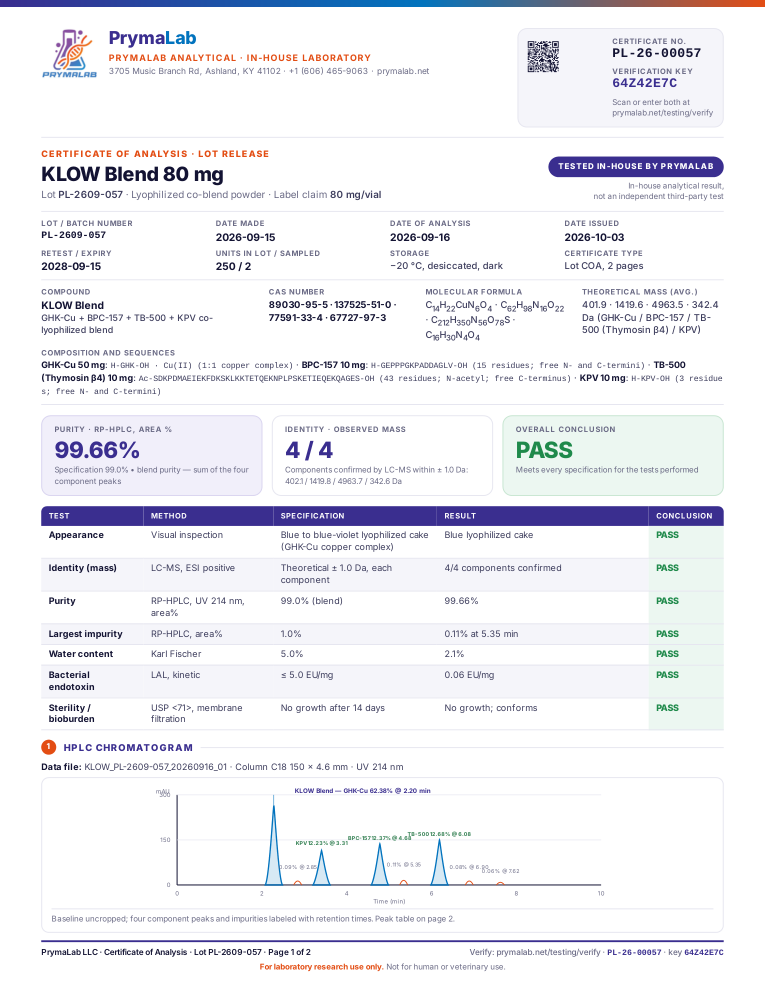
Page one summarizes the lot and results. Page two provides the analytical methods, peak table, mass data and approval details.
The report records a lot of 250 units, with two units sampled. Its conclusion applies to that named lot and the testing described; it is not a test of every container individually.1
What Did the KLOW Lot Testing Show?
| Test | Reported result | What it describes |
|---|---|---|
| Identity by LC-MS | 4 / 4 components confirmed | Mass results assigned to the four named components |
| Blend purity by RP-HPLC | 99.66% area | Combined area of the four component peaks |
| Largest impurity | 0.11% area at 5.35 minutes | Largest impurity peak reported by this method |
| Water by Karl Fischer | 2.1% | Water content of the sampled powder |
| Bacterial endotoxin by LAL | 0.06 EU/mg | Endotoxin result for the tested material |
| Sterility / bioburden | No growth; conforms | Reported USP <71> membrane-filtration result |
| Overall conclusion | PASS | Meets the certificate’s specifications for the tests performed |
Each row answers a different analytical question. Purity, identity, water content and microbiological results should be read together, with the test methods and stated sample scope.
What Does 99.66% KLOW Purity Mean?
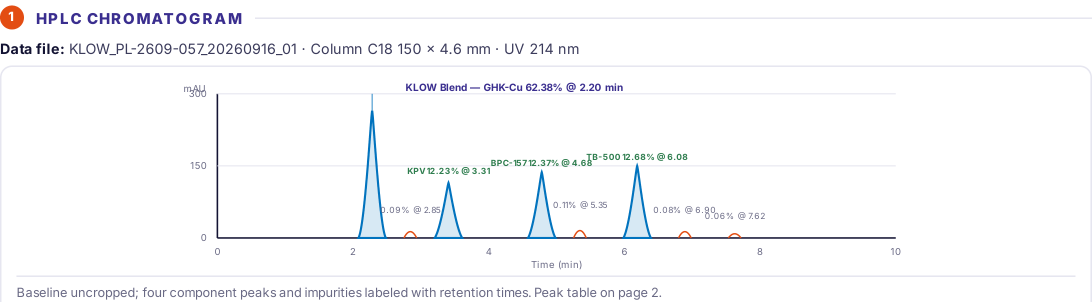
The certificate defines the headline result as the sum of the four component peaks in its RP-HPLC chromatogram. The reported areas are 62.38% for GHK-Cu, 12.23% for KPV, 12.37% for BPC-157 and 12.68% for TB-500. Together they add to 99.66%.1
This is a blend-level chromatographic result. It does not mean that each ingredient was individually assigned 99.66% purity. It also does not measure or verify the labeled milligrams of each ingredient in a vial.
Peak area
The share of the integrated chromatographic signal assigned to a peak under the reported method.
Labeled content
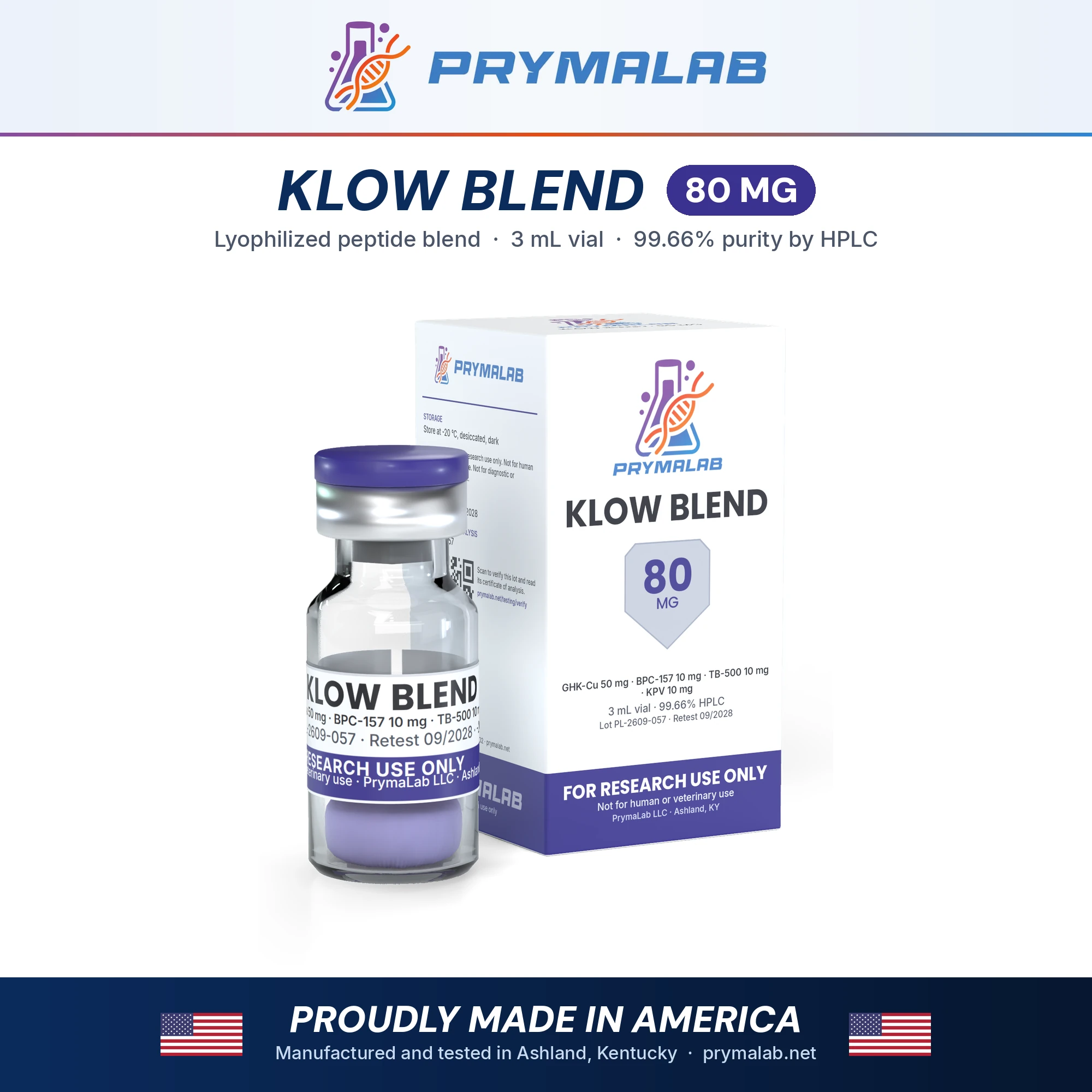
The product specification of 50 mg GHK-Cu plus 10 mg each of BPC-157, TB-500 and KPV per vial.
The full report includes a C18 column method, detection at 214 nm, a gradient program and the complete peak table. Those details give the result its analytical context.1
Which Ingredients Does the Certificate Identify?
The COA lists GHK-Cu, BPC-157, TB-500 and KPV, along with their sequences or structures and mass results. It reports all four components within its LC-MS acceptance criterion.1
One useful detail is the identity of TB-500. In this certificate it is N-acetyl thymosin β4, a full-length 43-residue peptide. BPC-157 is listed as a 15-residue peptide, KPV as the three-residue Lys-Pro-Val sequence, and GHK-Cu as a 1:1 copper complex.1
The composition, identity result and purity result belong together. The ingredient list says what the product is labeled to contain; the mass and chromatographic measurements describe what the laboratory reported in the sample.
Does This COA Test the Finished Autoinjector?
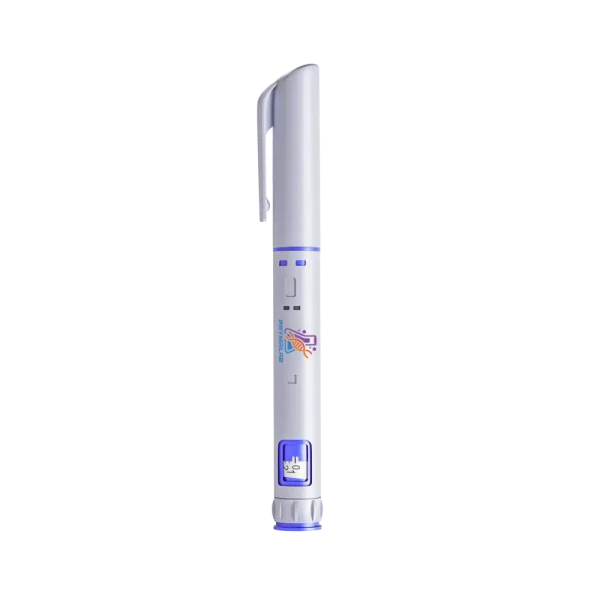
This document covers the named powder lot. The KLOW autoinjector listing says its supporting certificate concerns the peptide lot used to fill the pen, rather than the finished solution in the cartridge.12
The pen’s stated specifications are 3 mL at 80 mg/mL, or 240 mg of total blend. Those are product-label facts; they should not be presented as measurements from this powder report.2
Likewise, the powder certificate’s no-growth result should remain attached to its tested material. A separate finished-product result would be needed to describe testing of a particular filled pen.
The COA is analytical product documentation. It does not establish a human dose, clinical effectiveness or a treatment outcome.
Keep the Label, Lot and Certificate Together
Start with the lot printed on the container. Compare it with PL-2609-057 on this report, then confirm that the product form and composition match. If a later purchase has a different lot number, use the document for that lot.
Keep both PDF pages: the second page supplies the methods and approval information behind the summary. A screenshot of the purity number alone loses that context.
Storage instructions also belong to the format. The powder certificate specifies −20 °C, dry and protected from light. The pen listing specifies 2–8 °C, protected from light, without freezing. Follow the documentation that corresponds to the supplied product.12
80 mg
Original KLOW certificate
Lot PL-2609-057 · Certificate PL-26-00057
Sources and Product Documentation
- 1KLOW Blend 80 mg certificate of analysis
Original supplied two-page PDF, lot PL-2609-057 / certificate PL-26-00057. PrymaLab Analytical in-house results; issued 3 October 2026. - 2PrymaLab KLOW autoinjector listing
Primary supplier specifications for the 3 mL / 80 mg/mL format, storage conditions and the stated peptide-lot scope of its certificate.
Sources reviewed 2 November 2026. Personal reports, ingredient studies, product specifications and analytical results are identified in context.